PSOAS It Should Be
May 28, 2026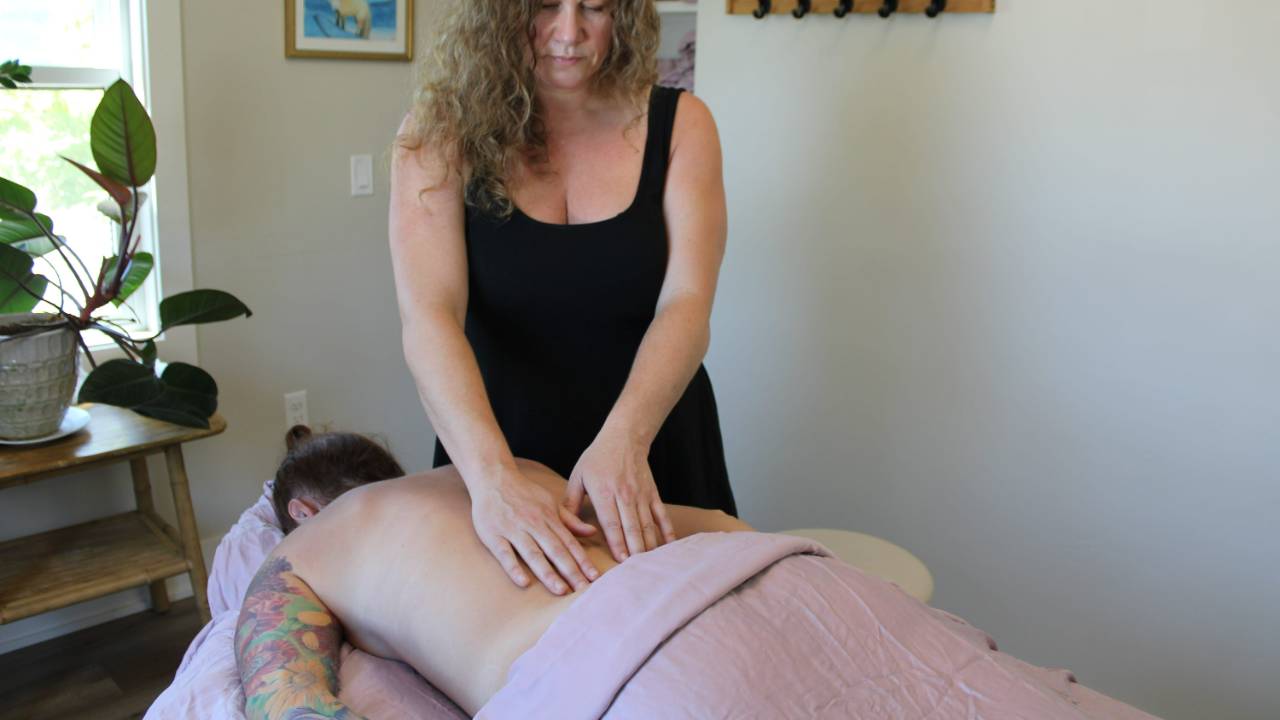
Most of us have a tendency not to notice the body unless it is in pain, or there has been an accident, injury, or trauma. I honor my teachers for their attention toward the profound simplicities. Breath and grounding are keys to living a happy life in the body.
Most of the time, when we are on autopilot milling about or charging through life, we are in the mind. When we get lost in thoughts about the past or the future, we overlook the present moment. The present moment is, in fact, where everything happens, and when our attention escapes to another time, we can become distracted, out of the flow, and focused on solving problems. Our attention often goes to the negative.
It’s important to interrupt the pain cycle, stop the negative feedback loop, and listen to the body. Breathing is listening.
Breathing is so simple that it is often overlooked, and yet it is the vital force that keeps us alive more than anything else. Breathing is the fastest way to regulate your nervous system, the best way to get in touch with yourself, and one of the quickest ways to relax.
When we look to the feet, we can find clues that are carried all the way up to the neck and head. Feet allow us to feel grounded. We can either pour into the earth and develop a healthy relationship with gravity, or we can keep efforting and hovering, lifting ourselves like an object-body.
How do we feel more grounded and supported by the earth? We pay attention to the way our weight is distributed through the feet. We also have a wonderful thing called the heel lead, where your heel strikes first. When you walk, notice whether your toes point in the direction you are walking.
One of the first things I direct my clients to is their feet. Your foundation—your feet, ankles, gait, and stride—has a profound effect on you as a whole organism. Because the feet are the furthest away from the brain, where many people identify and live from, they can be harder to sense, access, or receive feedback from.
When we have tension and holding patterns happening above the feet, the distribution of weight-bearing and uneven tension in the feet often contributes to the tension created above. Our foundation allows us to be agile or immobile.
As is below, psoas above.
In the body, we have relationships. Each part has a function and a role, and each of these jobs depends upon the community of parts working together to provide smooth sailing. When we have major players involved, we want to address these priority areas to free up the fascia and restore function to the fascial layers.
The body, simply observed, is a web of pulleys and levers. Myofascial Release frees restrictions in this web so that these parts can regain full range of motion.
In these tissues—muscles, tendons, and ligaments—we want symmetrical tensegrity: a positive, equally distributed tension that is pliable, toned, fluid, and hydrated. To extend, expand, and contract through our full range of motion, we need to be responsive, sensitive, agile, and nimble. We want the nervous system suspended and held in a wonderfully toned connective tissue matrix.
We release fascial restrictions and restore function with MFR.
Movement is another major key to creating health in the body. We want to feel able and strong. When we have an accident, injury, trauma, health issue, or are recovering from surgery, this can be challenging, especially when immobility is involved.
We need to keep moving, but what if that hurts? If an ankle is hard to walk on or the feet hurt, the rest of the body will compensate, moving in a compromised way that stresses surrounding areas because they are taking on roles they were not designed for.
When we have pain, it is natural to avoid it. Unfortunately, this can further exacerbate inflammation and create more adhesions and scar tissue as the body attempts to stabilize and protect itself.
It’s a balance. We want to favor an injured area until there is healing, but we don’t want to favor it for so long that we create a whole new dysfunctional movement pattern.
We can change these habits with Myofascial Release.
The psoas is a major player in the core. It connects the legs to the pelvis and the rib cage, traversing the body diagonally through the core. It inserts at the lesser trochanter of the femur and originates from the lumbar vertebrae, connecting to the lowest rib and the diaphragm.
The length and tone of the psoas affect the fullness of our breath. For healthy function, we want space and length in the psoas and differentiation between the core muscles so the psoas can do its job.
Psoas anatomy
-
Origin: Transverse processes of L1–L5 vertebrae, vertebral bodies of T12–L5, and adjacent discs.
-
Insertion: Lesser trochanter of the femur.
-
Action: Flexes the thigh at the hip joint and flexes the trunk.
-
Innervation: Anterior rami of the first, second, and third lumbar nerves.
In simpler terms: A tight psoas can make the lower back tight and cause the abdominals to lose tone. Fascial restrictions in this area can affect the nerves that supply the legs, ankles, and feet with sensation, circulation, and function because healthy lumbar innervation depends on healthy psoas tone.
If you experience pins and needles or legs that “fall asleep,” this may be related to peripheral neuropathy and the fascial health of the tissues surrounding the lumbar spine.
When people are diagnosed with degenerative disc disease, fascial restrictions often play a significant role. Imagine a tent whose ropes are pulled too tight. Over time, the tent poles bend under the constant tension. In the same way, chronically restricted tissues can gradually alter the size, shape, and function of bones and joints.
The hopeful thing is this: given the right space, time, and supportive conditions, just like plants, we can grow, change, and heal.
Healing happens with Myofascial Release.
Myofascial Release is a gentle, safe, and highly effective specialized form of bodywork. It releases fascial restrictions so tissues can breathe, hydrate, and return to a healthy tone.
Fascia is your connective tissue. It wraps every cell of your body and forms the structure that holds you up in space. With Myofascial Release, tissues become more pliable, flexible, agile, and strong. Your body becomes better organized and better able to support your movement and daily life.
You are treated as an individual with a unique life experience—with care and love.
My name is Angela Rose. I am an Injury Specialist and Myofascial Release Therapist. I help clients move out of chronic pain patterns and back into a healthy life doing what they love. I work with people recovering from surgery, injuries, falls, accidents, and both acute and chronic pain conditions who are looking for healthcare that is effective, gentle, and safe.
I practice at Sol Bodyworks in Grass Valley, and I look forward to serving you.
Categories
All CategoriesAuthor

Angela Rose
Author
Angela Rose is the founder of Sol Bodyworks, a Myofascial Release Therapist, Injury Specialist, and Presence-Centered Awareness practitioner. With more than 20 years of experience, she helps people move beyond chronic pain, restore natural movement, and reconnect with their bodies through compassionate, whole-person care. By integrating Myofascial Release, Presence-Centered Awareness, and coaching, Angela empowers her clients to cultivate lasting healing, resilience, and a deeper connection to themselves.